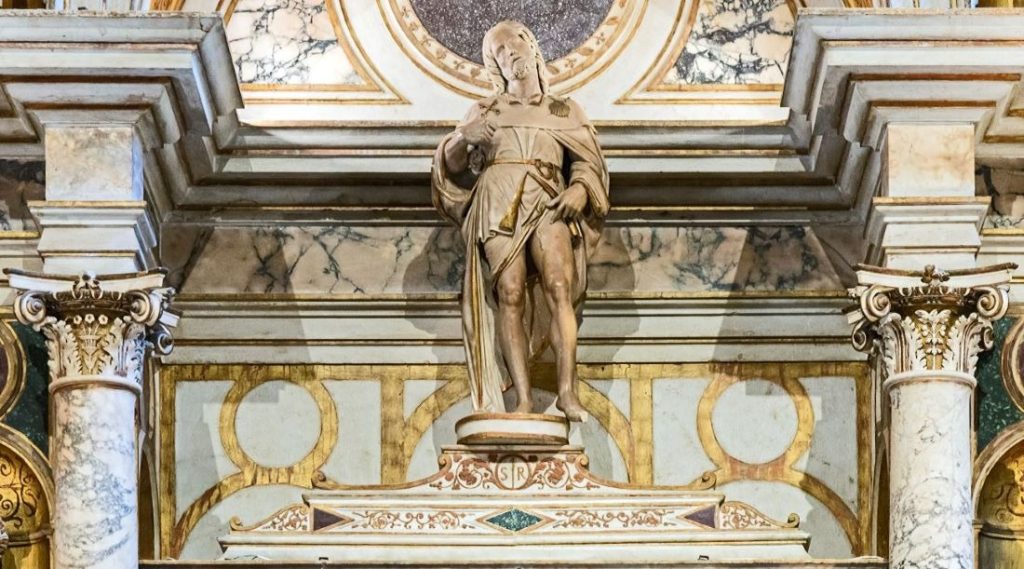
One of Europe’s most beloved saints, Saint Roch, was born in the French city of Montpellier into a noble family in 1295.
His parents were childless for a long time. They prayed and made vows, and God gave them a son. Saint Roch had a birthmark in the shape of a cross on his body from birth. After losing his parents before the age of twenty, he distributed to the poor the inheritance he had inherited from his father, a wealthy landowner, and as a poor pilgrim set out for Rome.

On the way, he performed good deeds and helped those suffering from the plague. He made pilgrimages to Rome, Rimini, Novara and Piacenza, visited public hospitals and performed works of mercy everywhere. Saint Roch healed the sick with prayer, touch and the sign of the cross. His journey turned into a pilgrimage of love.
In Piacenza, he himself fell ill with the plague and was banished from the city. He found refuge in the forest, where he ate herbs and drank water from a spring that flowed into his hiding place. His only friend was a hunting dog that brought him a piece of bread every day. The dog’s owner, Count Palastrelli, followed the animal into the forest and took Rok under his roof.
When he recovered, Roko returned to his homeland, but as the illness had completely changed him physically, his fellow villagers did not recognize him, but imprisoned him as a suspect and a spy. He spent five years in prison, contracted the plague again, and only revealed his identity to the priest who administered the holy sacraments to him.
He died in Montpellier, on this day, August 16, 1327. According to tradition, a heavenly light immediately appeared in his cell and an inscription was found: “All who suffer from the plague and seek the help of Saint Roch, the servant of God, will be healed.”
The veneration of this saint was greatly expanded by the Franciscans and Capuchins. He was included in the Roman martyrology by Pope Gregory XIII, and this entry was later confirmed by Pope Urban VIII. Through his intercession, healings soon began to occur, and the veneration of Saint Roch first spread to southern France and Italy.
When the plague broke out again in the second half of the 15th century, a brotherhood was founded and his veneration spread throughout Dalmatia and all of Croatia. His remains rest in the shrine of St. Roch in Venice, and believers invoke him for various needs, especially for protection from infectious diseases.
Numerous churches, chapels, and altars have been built in Croatia in honor of this saint, and on this day, many believers direct their prayers to Saint Roch.
Source: Laudato