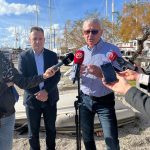
Arsen Ercegović: As many as 10,000 guests rest on our ships per week, and the lack of moorings puts our future in question
How was the season for small boaters?
The tourist season for our ships is still in full swing and we can say that it was solid. The previous records were not broken, but there was no shortage of guests on our ships either. According to the information that reaches us at the Association, the majority of boatmen are satisfied with this season.
How many guests are there and from which countries?
The Croatian Association of Private Shipowners has about 250 ships in its membership. If we know that most of these ships have 18 double cabins and can accommodate up to 36 guests, we can estimate that every week around 9 to 10 thousand guests rest on our ships cruising the Adriatic. The main countries from which our guests come are Germany, Austria, the USA, the UK, Australia, the Czech Republic, Poland, Slovenia, Scandinavian countries, the South African Republic and others.
How many destinations do you visit and which destinations are they?
Our ships visit almost all destinations on the Adriatic that are accessible by sea. The most important ports where our ships provide supplies and embark and disembark guests are the ports of Split, Trogir, Dubrovnik, Zadar, Rijeka and Opatija. The main routes of our ships depart from Split to Dubrovnik with various combinations of visits to the islands of Brač, Hvar, Vis, Korčula, Mljet, Lastovo and the cities of Omiš and Makarska. Some boats depart from Trogir on a similar route. We also have a route to Zadar with visits to Skradin and Krka Falls, Vodice, Primošten, Kornati, Silba, Šibenik, etc. We also have a northern route that includes Rijeka, Opatija, Rab, Zadar, Molat/Olib-Ilovik, Mali Lošinj, Krk, Cres and others. Due to the large number of ships and the lack of moorings in the ports, the agencies that bring our guests arrange a lot of diverse routes in order to avoid that there are too many ships at a certain destination on the same day.
What are the current biggest challenges of small shippers and how could they be solved?
Our main problems are:
-inadequate and insufficient moorings in ports during the winter period
-inadequate and insufficient moorings of our ships during the summer tourist season.
So, our first big problem is the inadequate accommodation of our ships in the winter season when they are not sailing but staying at the winter mooring. The existing Krilo port has been too small for a long time to secure a safe mooring of all our ships. We shipowners are in a specific position because, in accordance with the law, we are not allowed to build ports ourselves, but only port authorities have that right. That is why we have been trying to solve this problem for years by advocating for the improvement of the existing Krilo port and the commissioning and improvement of the Bajnice port, which could also take over a good part of our ships.
As a result of our efforts, the Port Authority of Split-Dalmatia County finally obtained a building permit this year for the development of the existing Krilo port. They announced that the renovation work will start this summer, but nothing has happened yet. Moreover, the Krilo port has long been designated as an alternative to relieve the port of Split, because our ships could change guests in the port of Krilo and thus relieve the port of Split, which is one of the busiest ports in the Mediterranean. And to make the problem even bigger, at the beginning of 2025, the Port Authority of Split will begin the reconstruction and extension of St. Peter’s Pier in the port of Split, and it will be closed for a minimum of 2 years. During the mentioned period, it will not be possible to tie up ships for tourist purposes, but only liner ships.
This is where we come to our second big problem, which is the lack of moorings for our ships in ports during the summer tourist season. We hear many complaints that we built our fleet spontaneously and that therefore there are not enough berths for our ships. Of course, we do not agree with these statements, since 2005 until today there are at least five strategies and action plans led by the Republic of Croatia with the aim of encouraging the construction of new vessels in Croatian shipyards, raising service standards and building the necessary port infrastructure, i.e. the construction of new ports.
For example, the Tourism Development Strategy of the Republic of Croatia until 2020, adopted by the Government of the Republic of Croatia in 2013, envisages an investment of 110 million euros in small floating hotels and the construction of a hundred new ships, as well as improving the quality of existing ships. At the same time, the construction of a new home port for small cruise ships and the expansion of existing ports for nautical tourism and ports open to public traffic are also planned.
We built the predicted 100 ships and our investments, growth and business development were exceptional, with great support from the institutions of the Republic of Croatia, especially the Ministry of the Sea, Transport and Infrastructure, initially with subsidies for the construction of new and reconstruction of existing ships and later with loans with subsidized interest from the Split-Dalmatia County, HAMAG-BICRO and HABOR. The entrepreneurship of shipowners – members of our Association, unfortunately, has not been able to keep up with the infrastructure, which has led to several key problems that have been significantly slowing down further growth and hindering the functioning of the existing fleet for some time now.
So, we built our fleet in accordance with the strategies and plans of our country. We have created a brand that is unique in Europe and in the whole world, and it is time that we be recognized and appropriately valued.
Admittedly, in the last couple of years, with the help of EU funds, our country has finally begun to reconstruct existing and build new ports (examples are the port of Stari Grad on Hvar and the port of Omiš), but unfortunately there is not enough room for our ships in these ports either.
If you visit the ports on the Adriatic during the tourist season, you will see that in some ports there are up to 10 of our ships moored in a row, from the shore to one on top of the other in 2 or even 3 rows. We are forced to do this because in most ports there is not nearly enough space for our ships, and often the ports prefer yachts and give them additional moorings because they say that they can earn more from them, which is contrary to the law that states that passenger ships have the priority of mooring, first liners and then others such as ours.
To make matters worse for us, a couple of years ago the Ministry of the Sea, Transport and Infrastructure announced the creation of a “Study on the Safety of Navigation, Docking, Anchoring and Staying in Ports and Port Areas” for all ports. According to these studies, a significant reduction in the number of moorings for our ships in most ports is foreseen, as the mooring of more than 3 ships in one row would no longer be allowed.
The association requested a postponement of the application of that study, so the Ministry of the Sea concluded last year that “Studies on the safety of navigation, mooring, anchoring and staying in the port and port area” will be gradually implemented in regulations on order in the port, depending on the possibility and dynamics of opening new moorings in alternative ports. Therefore, first of all, it is necessary to apply alternative solutions in terms of building new harbors or arranging existing harbors for the mooring of our ships, which we list here.
The solution to relieve the burden of the port of Split is the arrangement of the Krilo port; for the port of Hvar, the solution is the arrangement of the Viur port; for the Gruž port, the solution is the extension of Batakovina in a length of 400 meters; for the port of Pomena, the solution is to extend the existing operational coast with a breakwater about 60 meters long; for the port of Bol, the announced solution is the expansion of the existing port; for the Vis port, the solution is to build a new ferry pier outside the existing port; the solution for the Korčula port is the new port of Polačište. However, this year in April, the Port Authority of Split announced the implementation of this Study from the beginning of next year, despite the mentioned conclusion of the Ministry of the Sea and despite the fact that the work on the development of Krilo harbor has not even started yet, let alone finished. And then they also announced to us the above-mentioned reconstruction and extension of St. Peter’s Pier in the port of Split, due to which it will be closed for a minimum of 2 years. For us tourist shipping companies, this is an insurmountable problem, because the port of Split is the main and most important port where most of our ships load and unload guests and provide complete supplies. No less important is the fact that it is very important for our guests to visit the city of Split themselves with the widely known Diocletian’s Palace and other attractions.
As an alternative, the Port Authority of Split-Dalmatia County offered shippers a certain number of moorings on the part of the west coast in the port of Split, in the port of Trogir on the part that is now free, in the port of Kaštel Stari, in the port of Omiš and in the port of Makarska.
However, the big question is whether there will be a sufficient number of berths to replace all those we are losing in the port of Split. Also, it will significantly complicate the work of both agencies and shippers in every respect, and for us tourist shippers it is equal to a death sentence for our future successful business.