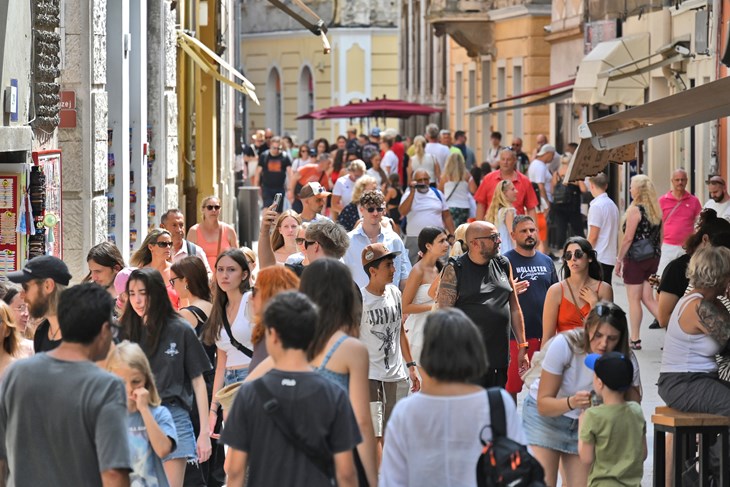
Source: Glas Istre
As many as 93 percent of Croatian citizens are planning at least one trip this year. At the same time, as many as 74 percent of respondents plan to spend their summer vacation within the country, which is on par with last year’s results. These are the data from the latest MasterIndex survey conducted for Mastercard by the Improve agency. The survey was conducted in March among 1,009 banking service users aged 18 to 55.
According to this data, Croatians are clearly not giving up on traveling this year either. However, in the circumstances of the war in the Middle East and the general energy crisis and the expected increase in prices, the question is how many of them will actually make it. Domestic tourism is quite contradictory. While large European countries, including tourism giants, base a good part of their tourist traffic precisely on domestic guests, in Croatia domestic traffic is still in the minority and accounts for about twelve percent of total overnight stays achieved throughout the year.
Shorter stays
The fact is that the domestic guest is impoverished, and the current global energy and economic crisis will definitely worsen the situation in Croatian wallets even further. Also, the domestic tourist offer is becoming less and less affordable for the average Croatian salary. Investments in hotels, camps and villas with swimming pools certainly attract the wealthier Western European guest. However, they are becoming less and less accessible to the average Croatian citizen. In fact, in the peak season, given the high prices, they have become absolute science fiction.
At first glance, it would seem that in such circumstances, domestic tourist traffic is in a drastic decline. However, the numbers say otherwise. Last year, 3.3 million domestic tourist arrivals were recorded, which is a nice 7 percent more. That is approximately 13.8 million domestic overnight stays, or 3 percent more than in 2024. 2024. Foreigners still account for more than 80 percent of the turnover. It is interesting to note that last year the strongest foreign source market, Germany, achieved 3.2 million arrivals and 22 million overnight stays. It turns out that there were actually even more domestic guests on holiday than Germans, although domestic guests achieved significantly fewer overnight stays. Namely, foreigners stay longer on holiday, while domestic guests are still mostly inclined to shorter stays. The domestic market is in second place in terms of physical tourist turnover, with 3 million overnight stays more than the third-placed Slovenians.
Before the coronavirus pandemic, in 2019, domestic guests made 900,000 less arrivals than last year. But practically the same number of overnight stays, which indicates a kind of rearrangement in the domestic market. Obviously, Croats decide on shorter stays more easily, and in many cases also in the pre- and post-season when the prices are still much lower than in the peak season.
We will spend more due to inflation.
Mastercard’s research also indicates that Croatians will spend more on their holidays this year than last. This is not surprising given inflation, so Croatian citizens will spend an average of 1,404 euros on their summer vacation, which is 158 euros more than last year. The highest planned spending is among those who will stay in hotels – 1,911 euros. However, the number of Croatians who will spend their summer vacation in hotels is by far the lowest. Only a fifth choose this more expensive accommodation, while half of domestic guests opt for the more affordable option of private accommodation. The research also says that – 35 percent of citizens choose their own real estate or stay with relatives and friends.
The director of the Croatian National Tourist Board (HTZ), Kristjan Staničić, said that the domestic market has been growing in recent years, stating that the trend has continued this year. He says that the HTZ has also contributed to this through a series of promotional activities, including the “Local Host” program designed last year. It will continue this year, as well as other activities to promote and highlight the uniqueness and diversity of the Croatian tourist offer, which can satisfy the appetites of domestic guests, especially during the pre- and post-season.
A stable domestic market is one of the important factors in the stability of tourism in any country, including Croatia, Boris Žgomba, president of the Association of Travel Agencies of the Croatian Chamber of Economy (HGK), pointed out to our inquiry. He states that, for example, in Italy, 40 percent of tourism is made up of Italians alone. The increase in the purchasing power of Croatians in recent years has inevitably reflected in the willingness of Croatians to travel.
Off-season vacation
– Domestic guests are predominantly pre- and post-season guests. They mostly travel outside the summer peak when prices are objectively the highest and it is clear that people are adjusting and going on vacation at a time when they believe they can afford it financially. I expect that the number of Croatians traveling this year will, if not increase, then at least remain stable and that the Croatian market will remain among the top three most important markets. And what a strong position it is and proves that no one should be in a position to not take into account the domestic market. It is extremely important, whether it is apartments, campsites, or hotels. Clearly, as in every country, you have people who can afford a 5-star hotel, but clearly the majority are oriented towards more affordable options, said Žgomba.
Representatives of the Slovenian tourism sector also provided interesting data on the travel habits of Croatians at a presentation held in Opatija. Livija Kovač Kostantinovič from the Tourist Organization of Slovenia (STO) pointed out that in the first two months of this year, Croatians were by far the most numerous foreign guests in the “country”, with more than 240,000 overnight stays.
– In the structure of our guests on an annual basis, the first three places are usually held by Germans, Italians, and Austrians. Croats are right behind, always in the top five most numerous guests. Croatian guests represent an important and stable part of Slovenian tourism. Last year, 370,000 Croatian arrivals and almost 780,000 overnight stays were recorded. This is a growth of as much as 11 percent, said Livija Kovač Kostantinovič.
Croatians stay in Slovenia for shorter periods, but come more often
She added that Croatians usually come to Slovenia for vacation outside the main season. They most often stay in hotels and show interest in winter active vacations and the offer of Slovenian spas. However, Croatian tourists also stay in Slovenia for shorter periods than others. Namely, an average of 2.1 nights, which confirms the trend of shorter but more frequent visits. Maša Priberšek from Terme Olimija pointed out that 80 percent of guests from Croatia still come to these Slovenian spas on their own, not through agencies. Luka Veselić from Terme Snovik stated that Croatians also look for outdoor activities on vacation – hiking, cycling and the like.
By the way, last year was one of the most investment-intensive for Slovenian tourism. The Slovenian tourism sector invested nearly 280 million euros in new capacities and new offers. Of this, 121 million are budget funds and European Union funds. Thus, Terme Olimija is opening a new family hotel, and Terme Snovik is opening a new nature hotel.
Value for money
Kristjan Staničić commented that so far this year, Croatia has recorded positive trends in the growth of tourist traffic. This, he said, is confirmation that Croatia has a stable position in the outbound markets. The goal is to grow in the pre- and post-season, which will continue the trend.
– As for the main season, especially July and August, in the situation of all the wars that are happening in our environment, no one can predict its course with certainty. However, we are ready to react at any time. We have reacted now after the start of the war in the Middle East by adjusting our campaigns. We have sent messages that we are safe and close to the most important emitting markets and offer adequate value for money, said Staničić.