Source: SEEbiz Foto: PBZ
Privredna banka Zagreb (PBZ), a member of the Intesa Sanpaolo Group, in cooperation with SRM, held a conference where a comprehensive report on the strategic role of Croatia’s blue economy in the global competitive environment was presented.
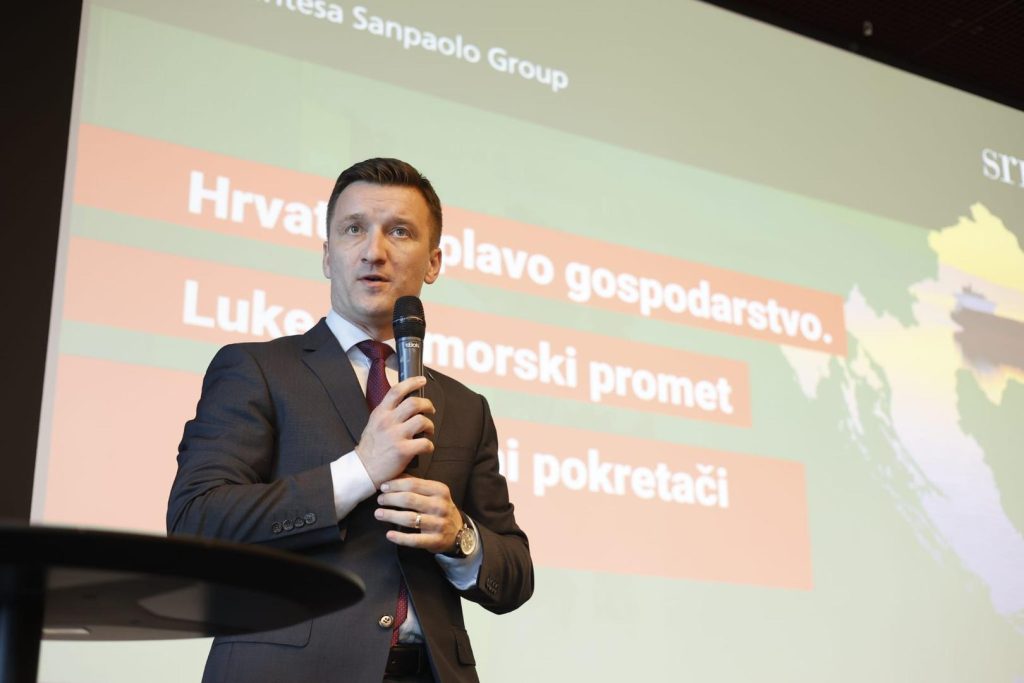
The event was opened by Dinko Lucić, President of the Management Board of Privredna banka Zagreb. He highlighted the importance of the Blue Economy as a long-term driver of growth and a strategic pillar of Croatia’s sustainable development.
“The sea is one of my favorite topics because it includes logistics, infrastructure, transport, but also tourism. Logistics routes, the role of the Mediterranean and Croatia, are becoming increasingly important. The Mediterranean has historically been the center of globalization, when trade chains opened up. The role of the Mediterranean was also important in a historical context, due to its opening up. There are now great opportunities for Croatia, and I especially emphasize the potential of the sea in the production of electricity,” said Lucić.
The importance of the lowland railway
The introductory institutional presentation was given by Žarko Tušek, State Secretary at the Ministry of the Sea, Transport and Infrastructure, who spoke about the state’s priorities in maritime transport, port infrastructure and connectivity. He particularly emphasized the importance of the lowland railway. The estimated value of the works for the entire lowland railway is around three billion euros, but a more precise value and deadlines for implementation will be defined after additional analyses.
“The lowland railway is part of three significant trans-European transport corridors, the Mediterranean, the Baltic Sea – Adriatic Sea and the Western Balkans – Eastern Mediterranean, which connect the port of Rijeka with Hungary and other Central European countries, so it also has broader regional importance,” said Tušek.
The strategic presentation of the report titled “Croatian Blue Economy – Ports and Maritime Transport as Key Drivers of Growth” was held by Massimo Deandreis, Managing Director of SRM – Center for Economic Research (Intesa Sanpaolo Group). The presentation provided insight into the Croatian maritime ecosystem, global logistics trends, port competitiveness and Croatia’s role in the development of international supply chains.
The report highlights several strategic messages that shape the future of Croatia’s Blue Economy.
“First of all, Croatia is a natural strategic entry point between the Mediterranean and Central and Eastern Europe. Thanks to its position on the Adriatic, Croatia offers direct and potentially more efficient access to EU and Balkan markets. This makes it an increasingly important entry point in European logistics chains that are in continuous development. The blue economy plays a key role for the country. Croatia is first in Europe in terms of the share of the blue economy in the gross added value of the national economy, with a share of more than 7% (4.1 billion euros) in total. The sector employs more than 150,000 people. The Croatian maritime network is increasingly focused on commercial trade and international logistics chains,” said Deandreis.
Growth of maritime traffic
The ports are handling increasingly extensive flows of goods and are gradually integrating with global markets, with foreign trade worth more than 66 billion euros (approximately a quarter of the Eastern Adriatic region) and key partners such as China and the USA, strengthening the country’s commercial role.
Maritime transport is recording steady growth and gradual qualitative improvement. Maritime trade is growing at a steady pace (around 3% per year), and the unit value of goods is increasing, indicating a shift towards higher value-added transport and increasing integration into international supply chains.
Digitalization and sustainability are key drivers for strengthening the competitiveness of the maritime system. The introduction of smart ports, IoT and digital technologies, along with investments in the green transition, aims to improve efficiency, traceability and logistics integration, bringing Croatia in line with the most advanced European standards.
Croatian ports, led by Rijeka, represent a growing hub within the Adriatic system.
Read more on SEEbiz!