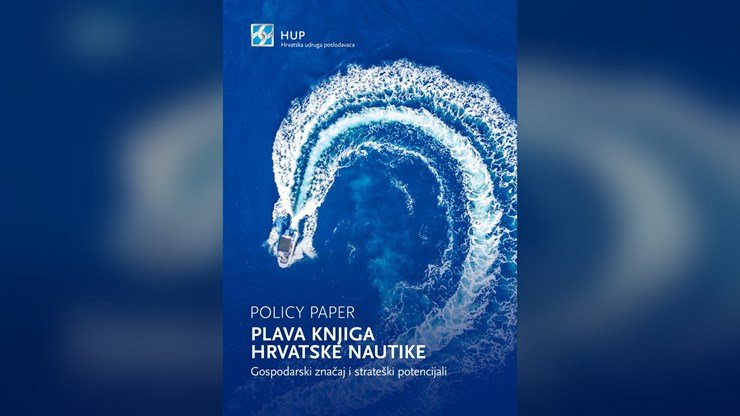
Source: Hrvatska udruga poslodavaca, suvremena.hr
The Croatian nautical sector is economically successful, export-oriented, and regionally recognized; yet, it is managed as a collection of disconnected activities. Marinas, charter operations, shipbuilding, equipment manufacturers, providers of vessel refit and maintenance services—along with the entire range of related nautical activities—operate side by side on a daily basis, but rarely as part of a unified, centrally managed system. Each segment tracks its own performance indicators, advocates for its own interests before the relevant authorities, and develops according to its own internal logic, while the state of Croatia lacks a cohesive development policy for the nautical sector as a whole.
This fragmentation carries a tangible cost: investment decisions are made without a view of the entire value chain, regulatory hurdles (such as concessions and spatial planning) are addressed on a case-by-case basis rather than systematically, and educational policy fails to keep pace with the sector’s actual workforce needs.
For this reason, the HUP – Nautical Sector Association has launched an initiative to comprehensively inventory, segment, and analyze the entire Croatian nautical system for the first time—not as a collection of individual activities, but as a unified economic segment. The outcome of this initiative—which includes a registry of over 3,200 mapped economic entities and the analysis presented in this document—is a proposal to establish a National Council for the Nautical Sector. This body would, for the first time, bring together decision-makers, local and regional government authorities, and representatives from across the entire nautical value chain to collectively manage the sector’s development.
In the nautical industry, an investor often has to simultaneously coordinate with the state, the county, the city or municipality, the port authority, the concessionaire of maritime domain, heritage conservation authorities, environmental protection bodies, and various government ministries; consequently, the greatest challenge for the development of the Croatian nautical industry is no longer attracting capital, but rather coordinating the system. A good example of this is Porto Baroš, as well as the Golf Srđ project in Dubrovnik—even though the latter is not directly related to the nautical sector.
According to an analysis in a HUP policy paper, businesses within the nautical value chain generated €2.8 billion in operating revenue and €1,019.6 million in export revenue in 2025, while employing 18,323 people (in full-time equivalent terms). Operating revenue grew by 9.4 percent, and exports by 14.8 percent, compared to the previous year. The analysis draws on a HUP registry containing over 3,200 mapped economic entities, categorized according to their actual activities related to the nautical sector. Mapping of the nautical industry reveals that, between 2021 and 2025, exports increased by 70.8 percent—rising from €597.1 million to over €1 billion. During the same period, the share of gross investments in fixed assets relative to operating revenue rose from 11.7 percent to 18 percent, highlighting the importance of investment for the sector’s continued development.
“For the continued growth of the Croatian nautical sector, more secure investment conditions, faster procedures, and the availability of a skilled workforce are essential. The ‘Blue Book’ shows that revenue per employee in the sector grew by 43 percent between 2021 and 2025—rising from 108.5 thousand to 155.1 thousand euros—which confirms the potential for generating greater added value. For this reason, HUP proposes the establishment of a National Council for the Nautical Sector, which would connect the business community with the relevant institutions to implement concrete development measures. We want to see more design, manufacturing, and servicing taking place in Croatia, ensuring that a larger share of the value created remains within the domestic economy, all while preserving our sea and coastline,” stated Irena Weber, Director General of HUP, during the presentation of the ‘Blue Book’ at this year’s Biograd Boat Show, held last week.
Read more on suvremena.hr!
You can download the document HERE.